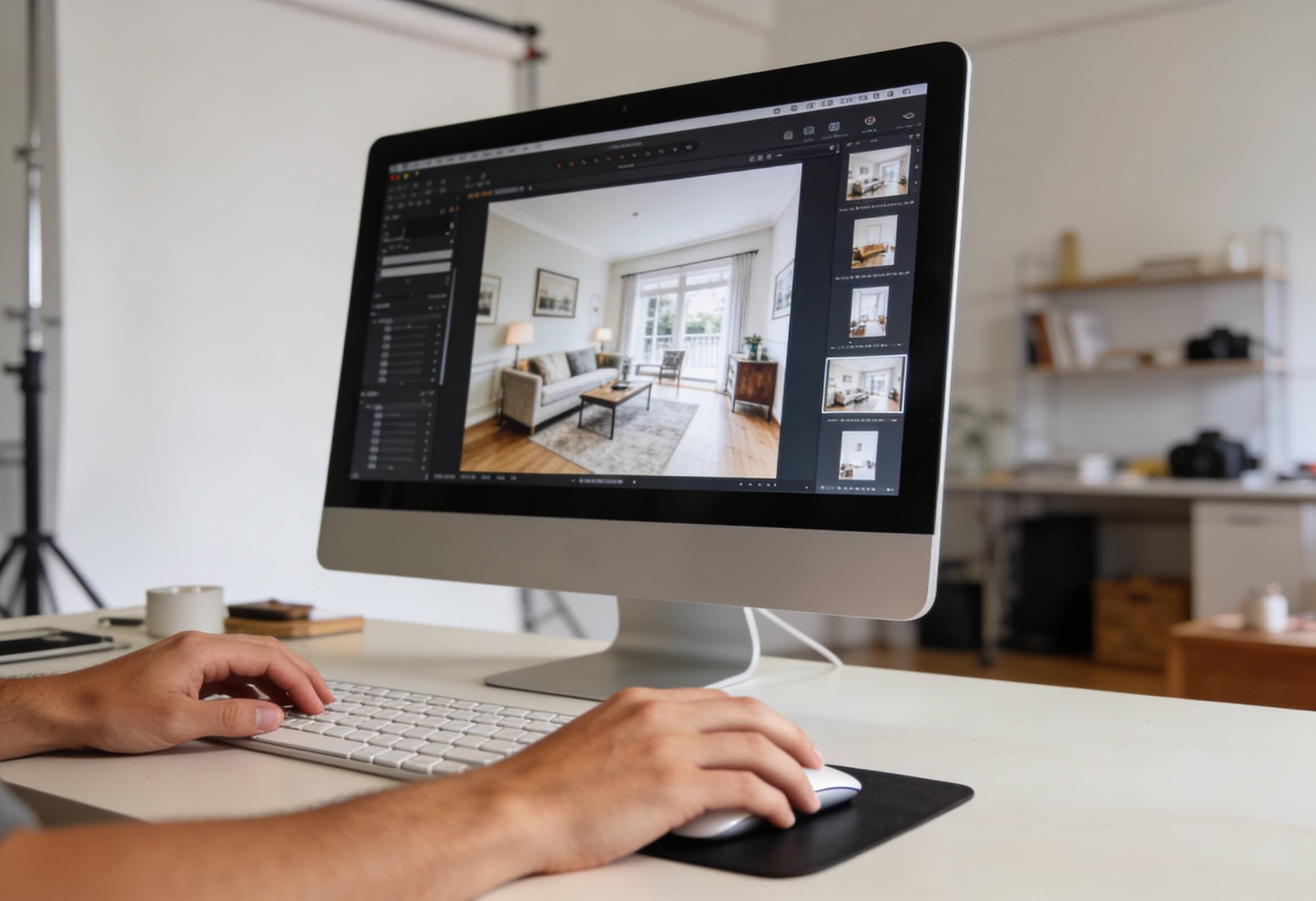
Manual editing teams, AI real estate photo enhancement services, and hybrid models all promise better images, but they solve different problems for photographers, media companies, and brokerages. You face daily decisions around turnaround time for new listings, the visual standard your brand stands for, and the real cost of hitting those deadlines. The question is which approach supports your growth without creating new operational friction. This article breaks down how manual, AI, and AI‑human workflows compare so you can choose a workable model.
The Technology Shift in Real Estate Photo Enhancement
Real estate photo enhancement has moved from fully manual editing toward AI‑first and hybrid workflows. We’ll explore what that shift means for your daily production and business performance.
From Darkrooms and Manual Retouching to AI‑First Workflows
Real estate visuals have moved through several distinct phases. Film labs and darkrooms gave way to digital cameras plus manual Lightroom/Photoshop work. Then came high‑speed internet, global editing teams, and standardized real estate presets.
Now AI‑driven tools add another layer: automated corrections for exposure, white balance, lens distortion, and basic contrast across large batches. Editing is no longer tied only to individual hands; it is supported by algorithms that can process thousands of frames in minutes, then pass them on to editors for refinement.
What “AI Real Estate Photo Enhancement” Actually Means Today
In practice, AI real estate photo enhancement services focus on pattern‑based, repeatable tasks. Typical capabilities include:
Detecting interiors vs exteriors and applying suitable baselines
Adjusting exposure, color balance, and contrast to a defined target look
Correcting lens distortion and perspective for common real estate focal lengths
Suggesting or applying sky swaps and light lawn upgrades under controlled rules
Most serious use cases still involve a human layer on top, but AI handles the heavy lifting for standard images so editors can concentrate on creative and complex scenes.
Read more: What Is AI Real Estate Photo Editing Software? Features, Benefits, and Use Cases
Why the Conversation Has Moved to Speed, Quality, and Cost
Once AI entered the workflow, the debate stopped being “old vs new tool” and started centering on business metrics. Teams now ask:
How quickly can large volumes be processed without losing control of style?
What visual standard can be sustained across every listing, portal, and market?
How do direct editing fees and internal coordination time shape overall cost?
Manual, AI‑only, and hybrid setups answer these questions in different ways, which is why speed, quality, and cost now frame most strategic discussions.
Manual vs AI Real Estate Photo Enhancement Services: Speed, Quality, and Cost
Manual and AI real estate photo enhancement services each bring clear strengths and constraints. Understanding their role across speed, quality, cost, and risk gives you a practical decision frame.
Speed: Turnaround Time at Scale
Manual editing relies on human capacity, time zones, and working hours. This allows for flexible handling of unique cases, but timelines can stretch when:
Editors juggle multiple urgent projects
Seasonal demand spikes or same‑day requests increase
Communication cycles add extra back‑and‑forth on feedback
AI editing delivers near‑instant or same‑day output for standard batches. Once images enter the system, they can pass through baseline correction stages in minutes, even at high volume.
Where each approach fits:
Manual excels on small, custom jobs, prestige listings, or images that require deep creative judgment.
AI shines in large pipelines, daily shoot schedules, and portal deadlines where predictable turnaround for hundreds or thousands of frames matters most.
Many teams already combine both: AI for the first pass, editors for final review on priority images.
Quality: Consistency and Visual Standard
Manual editing offers nuanced decisions on:
Color mood, composition, and local buyer preferences
How “warm” a home should feel for a specific region or segment
How aggressive to be with object removal, lawn enhancement, or sky swaps
Skilled editors read each space and adjust treatment so it aligns with property type and brand style.
AI editing delivers highly consistent treatment for standard corrections across huge volumes. Every image in a batch receives the same logic for exposure, white balance, and contrast, which helps portfolios look aligned on portals and in marketing decks.
Quality gaps typically appear in:
Tricky lighting with strong contrast between windows and interiors
Mixed color temperatures from multiple light sources
Heavy clutter, mirrors, and reflections
Brand‑specific looks that require subtle, context‑aware decisions
In those cases, human refinement on top of AI output protects realism and brand integrity.
Read more: How AI Real Estate Photo Editing Tools Are Transforming Property Marketing
Cost: Direct Editing Fees and Hidden Operational Costs
Manual services price primarily around labor:
Per‑image or per‑set fees that scale with volume and complexity
Premium rates for advanced work such as virtual staging, complex item removal, and high‑end retouching
This model is transparent but closely tied to human effort.
AI services often provide:
Lower marginal cost per image once configuration is in place
Subscription or usage‑based pricing that suits very large volumes
However, headline rates only tell part of the story. Hidden or indirect costs can include:
Internal staff time for quality checks and communication
Rework on difficult images that automated tools did not handle well
Launch delays that affect marketing campaigns and seller satisfaction
When evaluating cost, those operational elements matter just as much as the per‑image fee.
Risk and Control Across Both Models
Manual workflows depend on:
Editor training and documentation
Clear style guides and review steps
Robust quality control before delivery
Inconsistent training or vague direction can lead to variations in output across editors or shifts.
AI workflows depend on:
Model behavior and platform capability
Rules for different property types and lighting conditions
Exception handling for images that fall outside standard patterns
For both models, defined escalation paths are crucial. Images with complex lighting, high client visibility, or unusual requirements should route to skilled human editors for targeted attention.
Manual vs AI at a Glance
Aspect | Manual Editing | AI Editing |
Speed | Influenced by editor capacity and working hours | Near‑instant or same‑day for large batches of standard images |
Quality | Strong on nuance, local preferences, and brand‑specific “feel” | Strong on consistency for baseline corrections across thousands of frames |
Cost | Labor‑based pricing; higher impact from complexity and revisions | Lower marginal cost per image; often subscription or usage‑based models |
Risk & Control | Dependent on training, documentation, and QC steps | Dependent on model setup, rules, and exception handling paths to human editors |
Read more: 5 Best Real Estate AI Photo Editor Tools in 2026: Speed, Quality, and Scale
How to Decide Between Manual and AI Real Estate Photo Enhancement?
Choosing a model for editing is a business decision tied to scale, deadlines, and brand control. Use these angles as a checklist, not a one‑time exercise.
Assess Your Volume and Time Sensitivity
Start with the numbers and timelines you face each week.
Daily and monthly image counts for each photographer, media company unit, or brokerage office
Deadlines for portals, paid campaigns, and handover to agents or sellers
High and time‑critical volumes lean toward AI or hybrid. Smaller, irregular volumes can stay manual or move gradually into hybrid.
Map Your Typical Image Complexity
Not all portfolios look the same. Clarify your core profile:
Standard residential vs luxury, commercial, hospitality, or new development
Frequency of advanced needs such as challenging object removal, strong sky and lawn transformation, and mixed interior lighting
Portfolios with frequent tricky scenes benefit from a human layer on top of AI baselines or a highly trained manual team.
Define Required Consistency and Brand Style
Next, outline how tightly your visuals must align with a specific identity.
Degree of brand specificity in color balance, contrast, warmth, and composition
Need for distinct styles across markets or multiple brands under one group
If you manage several sub‑brands or regions, you may assign AI baselines for each style and have editors refine the final look for flagship campaigns and high‑value listings.
Identify Internal Skills and Capacity
Your current team shapes which model you can adopt smoothly.
Skills in manual editing, style guide creation, QA, and project coordination
Appetite to configure and operate AI tools directly vs collaborating with a specialist provider that manages the stack for you
A strong internal editing group might shift toward a hybrid to remove repetitive work. Lean organizations often gain more by partnering for both AI and human editing.
Consider Long‑Term Cost Structure
Short‑term quotes matter, but the bigger question is how costs behave as you grow.
Projected growth in image volume over the next 12–24 months
Budget preference for fixed subscription models vs variable, project‑based editing fees
AI or hybrid setups generally scale more predictably at high volume, while fully manual setups can suit studios with stable, selective portfolios and strong in‑house talent.
Read more: AI HDR Real Estate Photo Editing vs. Manual: Why It Works and How AI Is Taking Over
AI‑Human Hybrid Workflow: The Strategic Model for 2026
Hybrid workflows combine algorithmic speed with editorial judgment. Instead of choosing manual or AI, you assign tasks to the component that handles them best.
What an AI‑Human Workflow Looks Like in Practice
In a typical hybrid pipeline:
AI handles baseline corrections at scale
Exposure, white balance, lens corrections, basic contrast, and simple geometry adjustments are processed in batches. The system can also apply standard sky and lawn enhancements aligned with brand rules.Human editors refine and elevate
Specialists step in for complex scenes, subtle tonal work, local market preferences, and brand‑specific looks. They decide how interiors should feel for a given segment, and they manage advanced requests such as intricate object removal or tailored virtual dusk.
This division of labor lets AI do volume work and frees editors for judgment‑heavy decisions.
Why Hybrid Improves Speed Without Sacrificing Quality
Hybrid models shorten the editing cycle while still centering human oversight on images that matter most.
Initial processing happens fast, so agents and media teams see preview‑ready sets sooner.
Editors no longer spend hours on repetitive exposure and color fixes; they focus on high‑impact frames, difficult conditions, and signature brand styling.
Teams can support tighter listing schedules and bigger campaigns without expanding internal editing headcount at the same pace.
The result is a portfolio that moves quickly through production while still reflecting a curated visual standard.
Quality Control and Exception Handling
The strength of a hybrid workflow depends on how it treats outliers. Robust setups include:
Rules for flagging problematic images: For example, mixed lighting, strong reflections, heavy clutter, or VIP listings automatically enter a manual review lane.
Structured QA steps: Sample‑based checks per batch, style guide alignment reviews, and sign‑off criteria defined with clients.
Feedback loops into the AI layer: Human corrections inform presets and configuration so future batches benefit from each round of learning.
With clear exception paths, AI never acts as a closed box; it becomes a component in a wider, governed process.
Operational Benefits for Photographers, Media Companies, and Brokerages
For high‑volume real estate players, hybrid workflows change daily operations:
Delivery windows become more predictable across seasons and new markets.
Account managers and agents gain earlier access to image sets for copywriting, brochure planning, and campaign setup.
Scaling into additional regions or offices involves extending an existing pipeline instead of rebuilding editing teams from scratch.
You move from firefighting around editing capacity to a more planned, portfolio‑wide production model.
Read more: Why AI Real Estate Photo Editing Services Are the Future of Property Listings
Esoft: AI‑Human Real Estate Photo Enhancement at Scale
With over 20 years of experience alongside leading real estate businesses and media providers across markets and property types, Esoft designs editing workflows that align with your volume, timelines, and portfolio goals.
Our AI‑human workflow operates in two stages:
AI accelerates baseline corrections across large batches in line with pre‑agreed style frameworks.
Professional editors refine images, align them with brand and local expectations, and protect realism in the final output.
Esoft’s photo editing services cover your core visual needs:
AI Photo Editing
Photo enhancement & retouching
Premium photo editing
Virtual dusk
Social media photo
Conclusion
Manual, AI, and hybrid models each shape how fast you deliver, how stable your visual standard feels, and how editing costs scale as your portfolio grows. AI real estate photo enhancement services have unlocked high‑speed, consistent baselines, while manual expertise still matters for complex scenes, brand‑specific styling, and high‑stakes listings. A structured assessment of volume, complexity, and cost points naturally leads to an AI‑human workflow as a practical choice for 2026. To explore how our hybrid model for your business, contact the Esoft team today!
Related Blogs

Hybrid Real Estate Photo Editing Explained: The Best of AI and Manual Editing
AI Photo Editing

Real Estate Photo Enhancement Agency vs In-House Editing: Which Is Better?
Photo Editing
Manual vs AI Real Estate Photo Enhancement Services: Speed, Quality, and Cost
AI Photo Editing
How to Choose the Right Partner to Outsource Real Estate Photo Enhancement Services?
Photo Editing
Real Estate Photo and Video Editing Explained: Tools, Workflow, and Trends
Video Editing

Fast real estate photo editing: The new standard of turnaround time and quality
Photo Editing



Linh Phan
Content Strategy Executive
No Spam, Just Updates
Our fresh blogs provide technical and industrial information that helps strengthen your business. Sign up to be the first to receive the new updates